
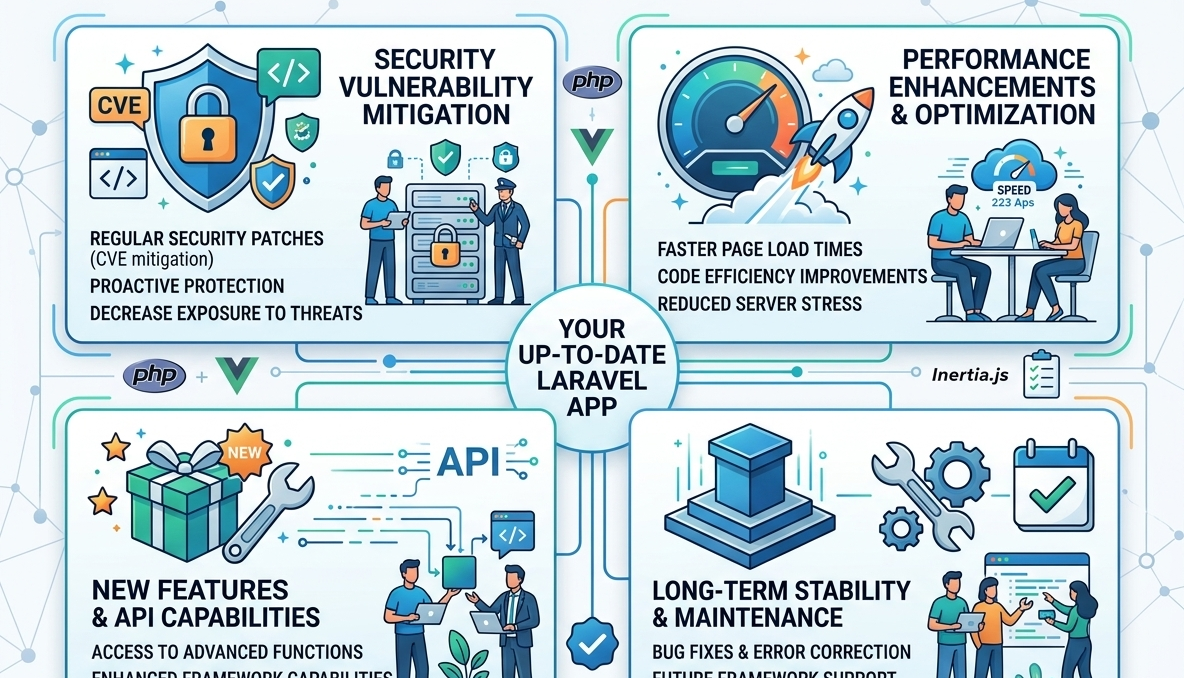
Building a Laravel web application is just the beginning. Once your platform is live and serving real users, the real work begins, keeping it secure, stable, and performing at its best. Many businesses invest heavily in development but overlook the equally important responsibility of regular maintenance. That oversight can be costly.
Why Regular Laravel Updates Matter
Laravel follows an active release cycle, with new versions introducing performance improvements, security patches, and modern PHP compatibility. Running an outdated version of Laravel doesn’t just mean missing new features, it means leaving your application exposed to known security vulnerabilities that hackers actively exploit.
Beyond the framework itself, your application relies on dozens of third-party packages and dependencies. Each of these has its own update cycle, and falling behind creates a compounding risk. The longer you wait, the more complex and expensive the upgrade process becomes.
Regular updates also ensure compatibility with the latest PHP versions. PHP itself receives security patches and performance improvements regularly, and hosting providers eventually drop support for older versions, leaving unmaintained applications suddenly broken or insecure.
Key Benefits of Keeping Your Laravel App Updated
- Security – patches protect against newly discovered vulnerabilities and exploits
- Performance – newer Laravel and PHP versions consistently deliver speed improvements
- Compatibility – stay current with third-party packages, APIs, and payment gateways
- Stability – regular maintenance catches small issues before they become major failures
- Cost efficiency – incremental updates are far cheaper than emergency large-scale upgrades
- SEO advantage – fast, secure, and stable websites rank better in search engines
What Happens When You Ignore Maintenance
An unmaintained Laravel application gradually becomes a liability. Security breaches, data leaks, broken integrations, and sudden downtime are common consequences. Worse, when a major update is finally needed, the gap between your current version and the latest can require significant rebuilding, costing far more than regular maintenance ever would have.
What to Look for When Hiring a Laravel Maintenance Developer
- Deep Laravel expertise – your developer should understand the full framework, not just surface-level features
- PHP and server knowledge – maintenance often involves server configuration, PHP upgrades, and deployment management
- Familiarity with your stack – if your app uses Vue.js and Inertia.js, your maintenance developer should understand the full stack
- Proactive communication – the best maintenance developers flag potential issues before they cause downtime
- Transparent reporting – look for someone who provides clear monthly reports on updates performed and issues resolved
- Availability and response time – critical bugs need fast responses, so ensure your developer offers reliable availability
- Long-term commitment – maintenance works best as an ongoing relationship, not a series of one-off fixes
Conclusion
A well-maintained Laravel application is a business asset that grows in value over time. Partnering with an experienced Laravel maintenance developer who understands both the technical and business dimensions of your platform is one of the smartest investments you can make for long-term digital success.